In shipping and logistics, disruption isn’t the expectation. It’s the cost of doing business.
Mechanical breakdowns on the road. Drivers out unexpectedly. Weather delays. Demand surges that stretch lead times and stress every part of the operation at once. For a boat trailer manufacturer delivering product across a network that stretches from Canada to Florida, west to Minnesota and Missouri, any one of these variables, or several at once, can impact weeks of carefully built shipping schedules, affecting not only current deliveries but future ones making their way through the production process.
“It’s like a domino effect,” said Stephanie Palmer, who manages logistics and fleet operations at Venture Trailers. “When one thing falls, everything after it has to be adjusted.”

It’s like a domino effect…when one thing falls, everything after it has to be adjusted.
-Stephanie Palmer, Shipping & Logistics Manager
It’s the kind of disruption that would throw a lot of manufacturers into a tailspin, scrambling to provide updates to dealers while customers are left waiting in the dark. But for Venture Trailers, this is where a relentless focus on operational precision proves its worth. Because when things go wrong, it becomes impossible to hide behind empty promises — and things will always go wrong.
A Plan Built From End to Beginning
Venture Trailers’ dealer network stretches from Canada to Florida, west to Minnesota and Missouri. On any given day, the company may be managing up to 1,000 active trailer orders simultaneously. Each order is tied to a waiting customer and boat.
Getting those trailers from the factory floor in Baltimore to a dealership lot in coastal Connecticut or rural Missouri is not a straightforward exercise in moving product from point A to point B.
“It’s like playing Tetris,” Palmer says. “We start by arranging the truck loads so they work well logistically and are cost-effective to get to those areas.” That dictates the build schedule.
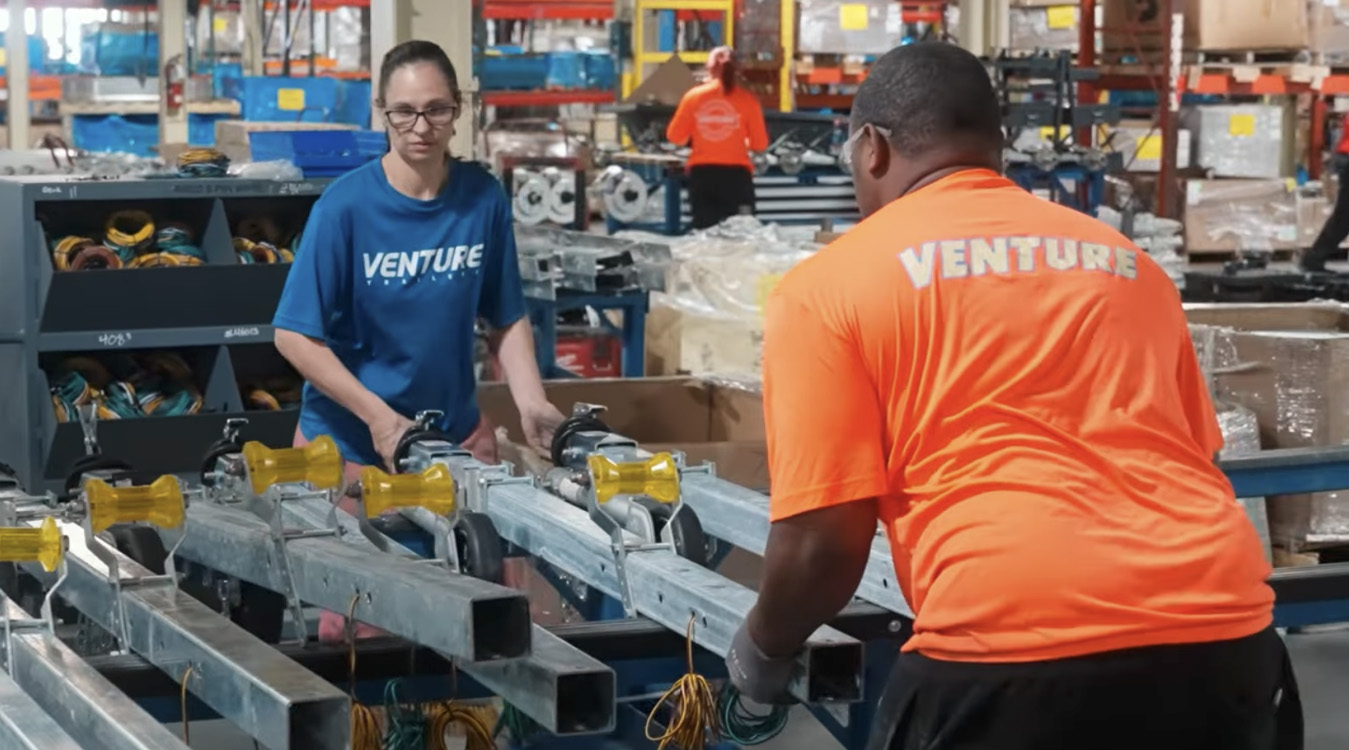
Trailers are built in batches, grouped by model type rather than by individual dealer order. It’s an approach that creates flow on the production floor, where components can be staged in advance and build teams can move through a day’s work without constantly shifting gears.
But the story really starts at the end, because driving the entire schedule is the expectation that the trailer will arrive at the dealership on time. Palmer has to work backwards from that date to determine exactly when a trailer will enter the production line — and balance that against the dozens of other orders moving through production at the same time. It’s a complex coordination of parts, inventory, people, time, and workload. And it all starts with where the trailer is going.
Palmer explains that every trailer build gets scheduled based on two variables: geography and size, which means every load has to be configured from scratch to maximize capacity, group shipments by proximity, and sequence stops so each dealer’s trailers can be unloaded without disturbing anyone else’s.
All of it gets documented in a detailed shipping and logistics plan that serves as the operational roadmap for the entire delivery process. “It’s my map for everything that I do,” Palmer says. The document is planned weeks in advance, tracking every load, every driver, and every stop. Dealers are never left guessing when their order is coming.
That visibility doesn’t stop once a trailer leaves the yard. Venture’s GPS tracking system provides real-time visibility into every delivery, allowing the team to monitor driver locations, track progress along the route, and proactively communicate updates to dealers. Whether a dealer wants to know where a shipment is, how far away it is, or when it is expected to arrive, the team can provide accurate information quickly. Venture is also developing future capabilities that will allow dealers to track deliveries directly, creating even greater transparency throughout the shipping process.
Working Around Complexity
The entire logistics operation is built proactively, and that’s precisely why when the unexpected happens,
Venture is prepared to handle it.
Long-distance and cross-border deliveries illustrate this most clearly. These runs involve additional credentialing requirements, longer turnaround times, and tighter driver availability constraints because DOT regulations limit how long a driver can legally drive before required rest periods. For most operations, those constraints become a ceiling. For Venture, they become a problem to engineer around.
Rather than defaulting to extended timelines when geographic or logistical hurdles arise, the team finds operational workarounds that protect dealer commitments. The guiding principle is simple: making dealers wait is not an acceptable answer. So when the standard approach won’t get a trailer there on time, the standard approach gets revised.
When the Dominoes Fall
When disruptions hit (and they do), the first thing that happens at Venture is a call to the affected dealers, before anyone has to ask.
“We are proactive instead of reactive,” Palmer explains. “I know your trailer’s due, but this is what’s going on. Here’s your rough date.”
Recovery teams are deployed to retrieve broken-down trucks and keep loads moving. Schedules are rebuilt in real time. The production team adapts in parallel, sequencing priority trailers to the front of the build line and routing them directly to the loading bay.
“You just have to pivot,” Palmer says. “Accept what it is, and make sure everything keeps moving. If the trailers don’t leave the yard, it’s not good for us, it’s not good for the dealer, it’s not good for anyone.”
Over the past several years, approximately 96% of Venture’s trailers have shipped on time across a delivery area spanning most of the eastern half of North America, and every unexpected variable that comes with running a long-haul logistics operation.
Back at the Dealership
Somewhere right now, a truck is pulling into a dealership lot. A driver is handing over paperwork. Someone from the dealer’s team is walking toward the load.
They didn’t see the build schedule, or the shuffle on the production floor, or the recovery run that made sure this truck left on time even after the plan had to be rebuilt from scratch.
They don’t need to. The trailers are there. And that is the only metric that matters.